


Final Report
Byamba's Final Report
The Seeds of Joy that Began in Japan
Stepping into the Land of the Rising Sun…
On September 23, 2024 — the International Day of Sign Languages — I set foot in Japan for the very first time to join the 24th Duskin Leadership Training Program. This was not just a journey abroad, but the beginning of my deep commitment to seek solutions to the challenges faced by Deaf people in Mongolia, to grow personally, and to learn as much as I could. Coming to Japan, leaving my four young children behind in Mongolia was a decision filled with emotional weight and sacrifice. But my strong will to learn and to contribute more to others gave me the courage to take this step.
From the moment I arrived, I was welcomed by Japan’s refined culture, cleanliness, warm social interactions, and advanced technological lifestyles. I was also introduced to fellow trainees from Taiwan, Bangladesh, and Nepal — individuals with shared aspirations. The nine months of interaction during which we encouraged and learned from one another have become an invaluable asset to me.
Language: The Gateway to Knowledge
During the first month of my stay in Japan, I faced a language barrier. It was difficult not being able to express myself fully or understand others, which limited my efforts to study and communicate. However, thanks to the support of four Deaf instructors who taught me Japanese Sign Language (JSL), I was able to overcome this challenge in a short time.
In Japan, I truly came to understand the phrase “language is the gateway to knowledge.” Learning JSL and written Japanese became the foundation not only for communication but also for achieving the goals I had set when I arrived in Japan. Learning Japanese Sign Language has given me access to a wide range of information, including TV programs by sign language interpreters and videos created by Deaf people themselves. It has also deepened my understanding of Japanese culture, social issues, and the lives and rights of Deaf people.
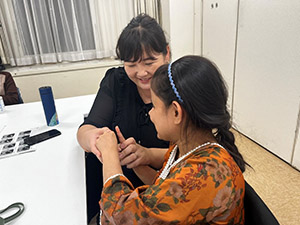
Byamba-san teaching sign language to Mitu-san while holding her hands.
Ten Days Living with Japanese Deaf Families
For ten days during the New Year holiday in 2025, I had the precious opportunity to visit and stay with Deaf families in Hiroshima and Nara. Through this experience, I came to understand and participate in the lifestyle, daily routines, and traditional customs of Japanese families. On January 1st, I visited the home of the parents of a Deaf host in Nara Prefecture. We celebrated the New Year together, enjoying a traditional holiday meal in a warm, joyful, and heartfelt atmosphere filled with laughter and good memories. I also visited historical sites in Hiroshima and Nara. Among them, Hiroshima Peace Memorial Park left a particularly strong impression on me. Learning about the damage caused by the atomic bomb and watching a video of a deaf atomic bomb survivor's testimony gave me a deeper appreciation for the importance of peace and the value of a world without war. What moved me the most was how two deaf families in Japan warmly welcomed me and kindly shared their daily lives and culture with me. I am filled with heartfelt gratitude.

Byamba-san preparing Mongolian food during her homestay.
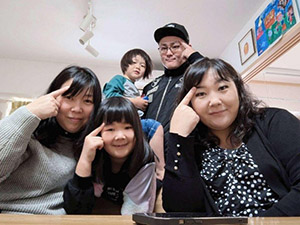
Byamba-san spending time with her host family during her homestay.
Individual Training That Deepened My Knowledge and Experience
From February to mid-May 2025, I participated in individual training sessions at government agencies, private organizations, and educational institutions throughout Japan. These training sessions were a very important opportunity to deepen my knowledge and practical experience to bring back to Mongolia.
I trained at the following organizations:
- Japan ASL Association
- The Graduate University for Advanced Studies, SOKENDAI
- Tottori Association of the Deaf
- Deaf Net. KAGOSHIMA
- Hyogo Association of the Deaf
- Tsukuba University of Technology
- National Rehabilitation Center for Persons with Disabilities
- Meisei Gakuen (School for the Deaf)
Through these trainings, I not only achieved the goals I set at the beginning but also gained a wider range of new insights and knowledge than I had imagined. Although I cannot cover everything due to space limitations, I must emphasize that each experience contributed greatly to my professional development and future endeavors. I was able to deepen my understanding of how Japanese deaf organizations are run, their organizational structure and leadership style, how projects are implemented, and strategies to promote community participation. I also learned a wide range of topics, including interpreter training and examination systems, curriculum construction and teaching methods. I also learned about the Japanese deaf education system, teaching methods, teaching materials, and how teachers work. In addition, I met deaf experts who are active on the front lines and was inspired by their experiences and process of overcoming challenges. I was able to gain a deeper understanding of social welfare services, employment support for deaf people, trends in sign language research, and the current state of policies and projects in Japan. I did not simply accept what I saw and heard, but always asked myself, "How can I apply this when introducing it in Mongolia?" and "What can I learn from Japan's challenges and failures?" as I engaged in the training.
Journeys Enriched with Experiences
Japan is one of the most travel-friendly countries, and I realized this deeply after joining short trips with Deaf friends. So far, I have visited 16 of the 47 prefectures, experiencing the nature, historical sites, delicious local cuisine, culture and customs of each region. Meeting and interacting with so many people was an experience that opened my eyes to a new world.
One particularly memorable experience was ski training in Niigata. I had tried skiing in Mongolia but wasn't good at it and felt unsure and fearful of trying again. But with the encouragement and support of my instructors, I not only learned how to ski but eventually managed to ski alone. This experience not only gave me a new set of skills but also boosted my confidence to overcome personal limitations.
These trips were not just for sightseeing or fun; they became moments of self-discovery, heartfelt memories, and lasting life experiences.
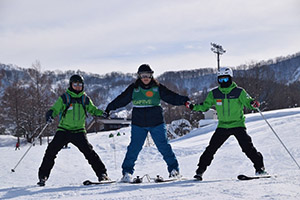
Byamba-san holding hands with the instructors during the ski training program.
Sincere Gratitude
Participating in this program and living in Japan despite for a short period of time has been an invaluable experience in my life and has made significant changes in both my personal growth and the development of my professional skills.
First and foremost, I would like to express my heartfelt gratitude to the Duskin Ainowa Foundation. Without their generous support and funding, this program would not have been possible. I am also deeply thankful to the JSRPD team for meticulously planning and organizing the program with such professionalism and care. Their attention to detail and encouragement were key to my successful learning journey. I would like to express my heartfelt gratitude to the organizations and individuals who provided me with the opportunity for one-on-one training. The knowledge and experiences you shared have become a valuable foundation for my future work. I am also deeply thankful to the teachers who devotedly taught me Japanese and Japanese Sign Language. My sincere appreciation also goes to my Japanese friends who kindly guided me through their beautiful country, making my learning journey even more enriching.
From all the experiences and people I encountered during this training, I learned deeply about the value of knowledge, the power of awareness, and human warmth.
I promise to bring back what I have learned to Mongolia and use it to promote the education, rights, and social inclusion of deaf people.
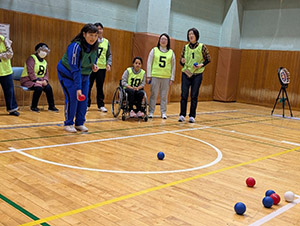
Byamba-san having fun playing boccia at the Universal Sports Festival.





Duskin Leadership Training in Japan
c/o Japanese Society for Rehabilitation of Persons with Disabilities (JSRPD)
1-22-1 Toyama. Shinjuku-ku. Tokyo 162-0052. Japan
TEL: +81-3-5273-0633 FAX: +81-3-5273-1523
E-Mail : duskin_training@dinf.ne.jp
Copyright © Duskin Leadership Training in Japan, All Rights Reserved.