


Final Report
Mitu's Final Report
A Journey of Empowerment and Inclusion:
My Duskin Leadership Program Experience in Japan
I am Taslima Sultana Mitu from Bangladesh. As a visually impaired individual, I had the honor of participating in the Duskin Leadership Training Program in Japan, starting on September 24 last year. Over the course of ten months, this journey has transformed me both as a person and professionally, empowering me to dream bigger and act with a greater sense of purpose.
At the beginning of the program, I studied Japanese language and Braille. Learning Japanese was quite a challenge, as I had no prior experience with the language. However, with the kind support of our language and Braille teachers and the dedicated staff of JSRPD, and with the encouragement from my fellow trainees, I gradually improved. Weekly report writing in Japanese helped strengthen my reading, writing, and speaking skills. I also took part in yoga classes, which helped me understand the importance of physical and mental well-being.
During the winter holidays, I had an opportunity to stay with two wonderful host families. Their kindness and hospitality made me feel safe and truly welcomed. Through these homestays, I was able to explore Japanese culture in depth, visiting temples, wearing a kimono, tasting new foods, and seeing snow for the first time. Each experience was a new discovery, filled with warmth and joy.
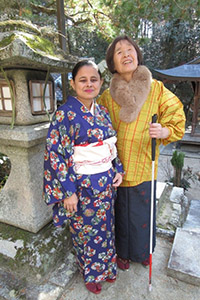
Mitu-san enjoying the experience of wearing a kimono at the home of her host family.
After the homestay, I joined fellow trainees in Niigata for ski training. It was my first time skiing, and though I was initially nervous, the instructors’ guidance helped me overcome my fear. I felt proud to challenge myself and discover new strength within.
During the group training segment, I learned about Japan's disability laws, welfare systems, and services. We visited various organizations and participated in sessions that taught us about universal design, accessibility, counseling, abuse prevention, and inclusive education. One of the most valuable lessons I took from this time was the importance of teamwork and the power of communication in bringing social change.
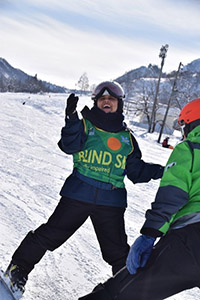
Mitu-san enjoying skiing on the snow-covered slopes during the ski training program.
My individual training allowed me to explore areas closely related to my interests. At universities and rehabilitation centers, I observed how visually impaired students are supported in education and employment. I spoke with blind professionals and learned about assistive technologies. I also experienced volunteer-based mobility training, which deepened my understanding of how independence is fostered.
At NPO Minori, I engaged in activities such as coffee roasting, making Braille business cards, preparing tennis balls, and gardening, all in a cooperative environment where people with visual and intellectual disabilities worked with dignity. At NPO With, I took part in packaging tasks and played sports like tennis and table tennis. I was especially moved when they prepared Braille instructions for me, making me feel truly included.
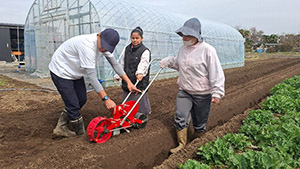
Mitu-san taking part in farm work with staff members during her individual training program.
I also visited key institutions such as Nippon Lighthouse, Japan Braille Library (JBL), and ATDO. At Nippon Lighthouse, I learned about welfare policies, Braille production, and employment services. At JBL, I explored the history and offerings of Japan’s largest library for persons with print disabilities. At ATDO, I was introduced to DAISY book production, which I hope to implement in Bangladesh to make books accessible to all.
A powerful concept I gained from this training is the importance of empowering people with disabilities to make their own decisions and live independently. I saw how assistive devices, employment support, and inclusive communities contribute to this goal. At the UNI, I learned about mobility support and captioning services. At the Nippon Lighthouse Information Center, I saw how volunteer efforts support independence and inclusion.
I also had an opportunity to introduce my own work in Bangladesh at organizations like “Shopno Bangladeshi Shikaku Shougaisha Shien Kyoukai (an association supporting visually impaired children of Bangladesh)” in Shiga and “Shapla Neer (citizens’ committee in Japan for overseas support)” in Tokyo. The advice and encouragement I received from Japanese professionals inspired me deeply and gave me new ideas for my future activities.
Outside of training, I enjoyed many cultural and recreational experiences visiting Hikone Castle, attending tea ceremonies, exploring museums, picking strawberries, and participating in music sessions and festivals. These moments taught me the importance of balancing work with joy and self-care.
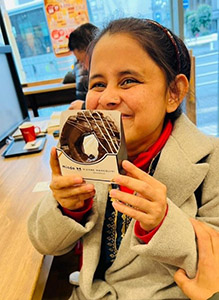
A smiling Mitu-san enjoying a chocolate doughnut on Reflection and Appreciation Day.
Throughout the program, I focused on three main goals: (1) to learn about services and daily life for/of people with disabilities in Japan, (2) to understand assistive devices for the visually impaired, and (3) to study Japanese language and culture. With the kind guidance and support I received from so many people, I have successfully achieved these goals.
Looking ahead, I hope to establish an information center in Bangladesh that will include a rehabilitation unit, sports facilities, a music studio, and a café where visually impaired individuals can work and thrive together. I also aim to provide accessible books, Braille materials, and assistive devices to promote education, employment, and independence of people with disabilities.
This journey in Japan has given me more than just knowledge; it has given me courage. I am committed to using these experiences to improve the lives of people with disabilities in my country. I will never give up until I achieve this dream.
Finally, I would like to express my heartfelt gratitude to everyone who made this journey possible. I am especially thankful to our dedicated teachers, the JSRPD staff, my two homestay families, and the organizations that warmly welcomed and supported me throughout. Your guidance and encouragement truly made a difference. Thank you for believing in me.
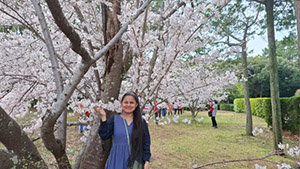
Mitu-san smiling under a cherry blossom tree.





Duskin Leadership Training in Japan
c/o Japanese Society for Rehabilitation of Persons with Disabilities (JSRPD)
1-22-1 Toyama. Shinjuku-ku. Tokyo 162-0052. Japan
TEL: +81-3-5273-0633 FAX: +81-3-5273-1523
E-Mail : duskin_training@dinf.ne.jp
Copyright © Duskin Leadership Training in Japan, All Rights Reserved.