


Final Report
Coco's Final Report
The Journey of Growth Carved Through Challenges
Introduction
My name is Coco. I am from Taiwan. I have cerebral palsy. I work as a social worker at the New Vitality Independent Living Association in Taipei.
About Taiwan
Taiwan has systems for people with disabilities, but there are still many problems. Many people with disabilities cannot live alone and need their families’ help. Students with disabilities can attend regular schools, but discrimination still exists. The gap between cities and rural areas is large, and rural areas have fewer barrier-free facilities. Therefore, there is still much work to be done in Taiwan.
Starting Life in Japan with Both Anxiety and Excitement
Before going to Japan, I was full of excitement and anxiety. I didn’t know if I could live alone in a foreign country or what my future would look like. Although I felt unprepared, I departed for Japan. My biggest concern was the language barrier. I worried about whether I could understand English and Japanese, how to learn the language, and how to express my feelings.
During the training and leisure period, I visited various places in Japan. While in Tokyo, I often challenged myself to explore alone and visited many tourist sites. Living in an unfamiliar town was a very important experience. Facing many unknown challenges by myself, I sometimes got lost but was able to find the right way by looking at maps and asking people for directions. These experiences helped me gain confidence and improve my adaptability.
Walking Together and Never Giving Up—Overcoming Difficulties
Studying Japanese was very difficult for the first three months. Because of my cerebral palsy, speaking was hard. However, my teachers helped me find study methods, and I learned various ways to express myself. Not only speaking but also writing was an important form of expression. Gradually, my Japanese improved. After returning to Taiwan, I want to continue studying Japanese, read more Japanese information, and interact with Japanese friends.
During my homestay in Yamaguchi Prefecture, I experienced many aspects of Japanese culture. I wore a kimono and visited a shrine to pray. It was my first time using Japanese to communicate with my host family and we found ways to communicate together. Although I caught the flu during the New Year’s, I overcame the difficulty with my host family and felt closer to them.
The ski training was scary at first. To make the "impossible possible," a lot of preparation, design, and support are needed. Ski instructors conduct much research, improve equipment, deeply understand disabilities, and prepare behind the scenes to allow people with disabilities to ski freely and safely. At first, I couldn’t control the movement well and failed many times. But in the end, I was able to control direction, maintain balance, and ski steadily on my own. I was truly happy and enjoyed the moment of success—it was an unforgettable experience!
I traveled to various places with fellow trainees, sharing many experiences, which brought us closer together. Together, we worked hard, never gave up, and overcame difficulties.
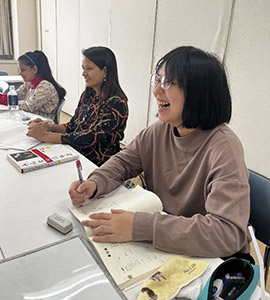
Learning Japanese. She appears to be enjoying the class with Mitu-san and Laxmi-san.
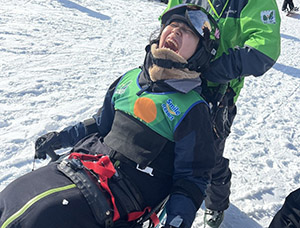
Coco-san enjoying adaptive skiing during the ski training program.
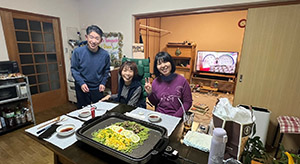
During her New Year homestay, Coco-san enjoying kawara soba, a local specialty of Yamaguchi Prefecture, with her host family.
Growth Gained from Diverse Learning and Experiences
The training included group and individual sessions. In the individual training, I visited various independent living centers and companies: YAH!DO Miyazaki, Independent Support Center Oita, Tsukuba Center for Independent Living Honyara, Independent Living Muchu Center, Partner, Mainstream Association, Movement, Center for Independent Living Realize, Center for Independent Living Aruru, Center for Independent Living Connect, and OMRON Taiyo Co., Ltd.
From both group and individual training, there were eight important lessons: disability welfare systems, independent living, universal design, activities by young people with disabilities, disaster prevention, inclusive education, community exchange, and play.
I learned about disability welfare systems — laws, systems, and history of the movement. Comparing such situations with Taiwan, I deepened my understanding. I felt that cooperation with communities leads to better support. At a parade I joined themed “A city where everyone can live comfortably,” I experienced a spirit of cooperation. Both Japan and Taiwan truly hope for systems and societies where people with disabilities can live safely.
Regarding independent living, I learned the meaning of "choose by yourself, decide by yourself, take responsibility yourself." I felt that self-directed support services like independent living programs, peer counseling, and assistance are very important. I also learned about examples of community life for people with severe disabilities, mental disorders, and intellectual disabilities. I learned that it is necessary to provide appropriate support according to the characteristics of the disability and the wishes of each individual. After returning to Taiwan, I want to improve independent living systems further.
For universal design, I experienced designs and facilities that anyone can use easily in tourist spots, workplaces, and transportation. For example, place design, assistant support, and use of tools are important. We learned ways to enjoy hot springs more safely and comfortably with assistants and assistive devices. I also learned the difference between barrier-free design and universal design. I participated in barrier-free, reasonable accommodation, and hospitality training. It is very important for people in the shopping street to understand disabilities well. Considering diverse people allows people to use services more comfortably and participate in various activities.
In Kansai, I thought it was wonderful that young people with disabilities could grow while engaging in activities with peers. Activities of disability organizations (DPOs) are very important as places for connection and learning. Supporting each other strengthens the ability to face difficulties.
For disaster prevention, we experienced evacuation shelters and created individual evacuation plans. It is important to consider disaster prevention from the perspective of people with disabilities, and to always be connected to the local community, not just being prepared.
In group training, I learned about study methods using DAISY materials. In individual training, I learned about community activities, theater, and special needs schools. I learned the concept and practice of inclusive education. Inclusive education is important, and crucial for students, teachers, and other people to interact equally, and understand and respond to people with disabilities.
In group training, I learned about the CBR Matrix and Twin Track Approach, and finally understood what I had been struggling with for a long time. Using the CBR Matrix allows a deep understanding of the lives and issues of people with disabilities in the community and helps consider directions for action. Therefore, to advance plans, it is necessary to improve skills in facilitation, coordination, communication, and negotiation and keep practicing. I also want to learn more deeply about CBR and CBID. I participated in community exchange activities. Places where people with disabilities and community members can interact and help each other are very important. It is also important for people with disabilities to participate in society. Thanks to community exchange, more people have come to understand disabilities in daily life and have a broader understanding when interacting with people with disabilities.
Regarding play, I had many new experiences and challenges and was able to check barrier-free conditions in different places. There were many unforgettable experiences.
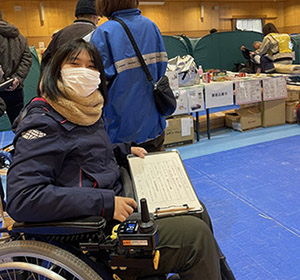
Coco-san learning about disaster preparedness during her individual training program.
Summary
During the training, I learned that “a place to belong,” “companions,” “aspirations,” and “LEAD ON (passing on / moving forward)” are very important. In order to create a truly inclusive society in which everyone can participate, and we must work hard together with or without disabilities, help each other, and grow together. It is important that we continue to move forward to improve society in which everyone is equal and their dignity protected.
My Dream: Beyond Barriers, Toward a Society Where Everyone Walks Together
After returning home, I want to create inclusive spaces for everyone to participate. I want a society in which more people with disabilities can live in the community. I want to further improve Taiwan’s disability welfare system. I will focus on advocacy activities and youth empowerment in disability organizations (DPOs). I will also interact with other independent living associations in Taiwan. Furthermore, I want to convey the ideas of universal design and inclusion to communities, schools, companies, and public institutions.
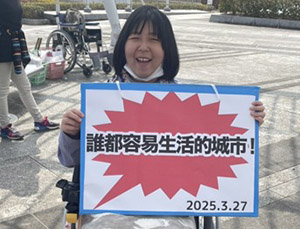
A smiling Coco-san taking part in advocacy activities with a Chinese-language panel at the Center for Independent Living Honya-ra.
Inner Change
Before coming to Japan, I always thought, “I want to live, study, and work just like everyone else,” and worked very hard. But through those efforts, I often felt mentally exhausted and pressured. I thought, “I must not fall behind” and “I must not be different from others.” However, through the training in Japan, and through many learnings, presentations of my personal history, and dialogues with people with disabilities and supporters, I was able to reorganize my life. I realized my past experiences were not only painful but also important forces that helped me grow. I gradually came to feel that I had value, without having to prove my existence.
I learned that when troubled, it is important to try various methods by myself and consult those around me. Anxiety and tension in my heart gradually calmed. Even when difficulties and challenges come, I feel I am developing the ability to stabilize my mind little by little. I want to continue walking at my own pace with a soft and stable feeling.
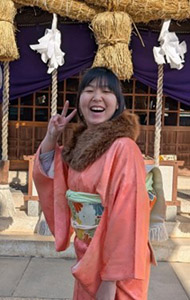
Coco-san in a pink kimono during her New Year homestay, beaming with a bright smile and making a peace sign.
The End of the Journey and a New Beginning
During the training, I learned many new things and experienced various Japanese cultures. I came to know myself better. I became happier, kinder, and stronger than before. Hope emerged, and I gained the strength to move toward the future. I sincerely thank the Duskin Ainowa Foundation, the Japanese Society for Rehabilitation of Persons with Disabilities, Toyama Sunrise, my teachers, and the training center staff. I will never forget their kind teaching and warm support. I look forward to seeing everyone again.
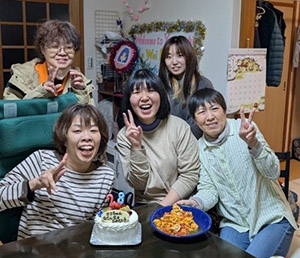
Celebrating her birthday with her host family and posing together for a commemorative photo.





Duskin Leadership Training in Japan
c/o Japanese Society for Rehabilitation of Persons with Disabilities (JSRPD)
1-22-1 Toyama. Shinjuku-ku. Tokyo 162-0052. Japan
TEL: +81-3-5273-0633 FAX: +81-3-5273-1523
E-Mail : duskin_training@dinf.ne.jp
Copyright © Duskin Leadership Training in Japan, All Rights Reserved.