


Final Report
Laxmi's Final Report
On Being a Good Leader and Motivating Newcomers with Disabilities
This training was a big opportunity to change my life. Before the training, I already knew about the Duskin Leadership Training Program because I was working at the independent living center Lalitpur Nepal, with the 6th Duskin trainee, Mr. Krishna Gautam.
Japanese Language
I had tried to study Japanese language in Nepal, but there were no accessible classes. That is why I was not able to study Japanese. When I came to Japan, I started Japanese language classes at Toyama Sunrise. I was impressed because the teachers were very kind and taught us in a way that was very easy to understand. I also put my mind into working hard. I never got bored with the Japanese class, right to the end. My speaking and writing skills improved day by day. It was a big achievement for me. Japanese language will also be useful in Nepal because I am working at the independent living center Lalitpur, Nepal, which is being supported by Japan.
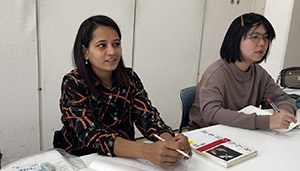
Laxmi-san listening attentively to her teacher in Japanese class.
Homestay
I stayed in Nagoya for roughly ten days for a homestay program. My host Ayumi-san was a very helpful person, she already knew about my disability well, and that was why she already had things important for me ready, such as a catheter and a rubber sheet, which I use daily. She always took care of me like a sister. We celebrated the New Year at her house, and I enjoyed feeling like they were my own family. Every day I went to meet her Japanese friends and visited different places with her by accessible car. I spent a memorable time experiencing Japanese culture and Japanese food.
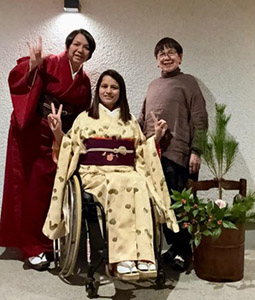
Laxmi-san in a yellow kimono during her New Year homestay.
Experience
In Nepal, we do not have a sea, but I like the sea and swimming in the sea. That is why I requested the staffs in the center that I wanted to swim in the ocean. However, everybody kindly said to me, “It is very cold now, so not a good idea”. Finally, I went to the sea, in Kobe, with the members of Mainstream Association and swam. Swimming in the sea is very different from swimming in a pool.

Laxmi-san enjoying a swim in the sea in Kobe with a big smile.
Group training
During the group training, I learned the development of disability related laws and policies in Japan, Inclusive education, abuse prevention, facilitation and reflection, transition of movement for/by persons with disabilities in Japan and its characteristics, and social welfare services. I will need to work in a team and ensure regular negotiation to change our society, policy, and laws.
Individual Training
During my individual training, I went to various independent living centers in Japan. For example, CIL (Center of Independent Living) Iruka in Okinawa, CIL Kirara, CIL Oita, AJU The House for Independence, CIL Hikari in Kagoshima, Mainstream Association, Independent Living Muchu center, and CIL Partner. I got to know about the concept of independent living and the lives of people with disabilities in Japan. I was also surprised to see the lifestyle of people with severe disabilities using technology and PA services. I also learned about the history of independent living and how to do activities, such as barrier-free campaigns, PA support systems in Japan for persons with disabilities, independent living programs, peer support, peer counseling, etc. I think peer counseling and peer support are very important for empowering people with disabilities. Self-acceptance is also very important for people with disabilities before they engage themselves in activities to change society. “Making choices and decisions by oneself and taking responsibility for the choice and decisions, one has made,” is the most important concept in the independent living movement. However, in most developing countries around the world, it is still believed that people with disabilities have to live with their families even as adults. Usually in these countries, there is no barrier-free infrastructure, no helper system, no government pension. Despite all this, I believe that in the future, people with disabilities in Nepal will also be able to live independently.
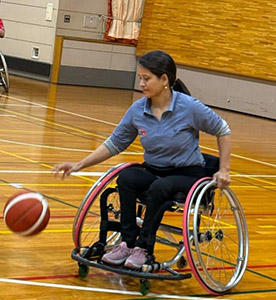
Laxmi-san playing wheelchair basketball.
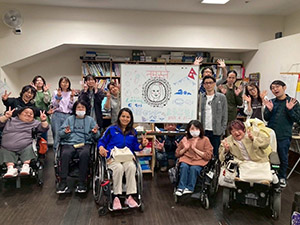
With everyone at Muchu Center. The drawing on the whiteboard looks exactly like Laxmi-san!
OMRON Taiyo Co., Ltd
I visited OMRON Taiyo Co., Ltd. It is a big company. I saw their working system in Japan. There are a lot of people with disabilities working together with people without disabilities. If people with disabilities have access to barrier-free infrastructure and technology, they will also be able to do everything.
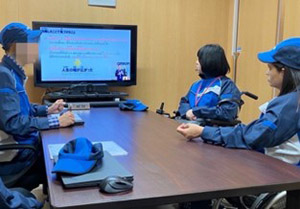
Training at OMRON. Wearing a work uniform, Laxmi-san listens attentively to the staff member's explanation.
Conclusion
In my country, there are so many issues surrounding people with disabilities. They include presence of so many barriers, and people not knowing anything about independent living. There is no barrier-free environment and infrastructure, and that is why so many people with disabilities have few job opportunities and education. In particular, people with severe disabilities only stay at home. However, I would like to solve this problem step by step. It is difficult to work on these issues alone, so first, I would like to bring some peers together and also consult with my seniors. I would like to tell many people about the things that I learned in Japan. I will work with other disability organizations and work together to receive disability services by the government. In particular, I want to work on inclusive education in Nepal and PA support system for persons with severe disabilities. Nothing is impossible if we work together for change little by little.
Thanks.
I would like to express my thanks to everyone, including my teachers, host family, the members of the centers I visited during my individual training, the Duskin AINOWA Foundation and the JSRPD team. Your work is wonderful. You have helped people with disabilities from various countries of Asia, teaching them many important things in Japan. I will be committed to working hard for people with disabilities after I go back to my country.
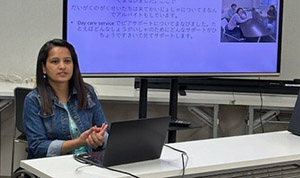
Laxmi-san presenting her life story.





Duskin Leadership Training in Japan
c/o Japanese Society for Rehabilitation of Persons with Disabilities (JSRPD)
1-22-1 Toyama. Shinjuku-ku. Tokyo 162-0052. Japan
TEL: +81-3-5273-0633 FAX: +81-3-5273-1523
E-Mail : duskin_training@dinf.ne.jp
Copyright © Duskin Leadership Training in Japan, All Rights Reserved.